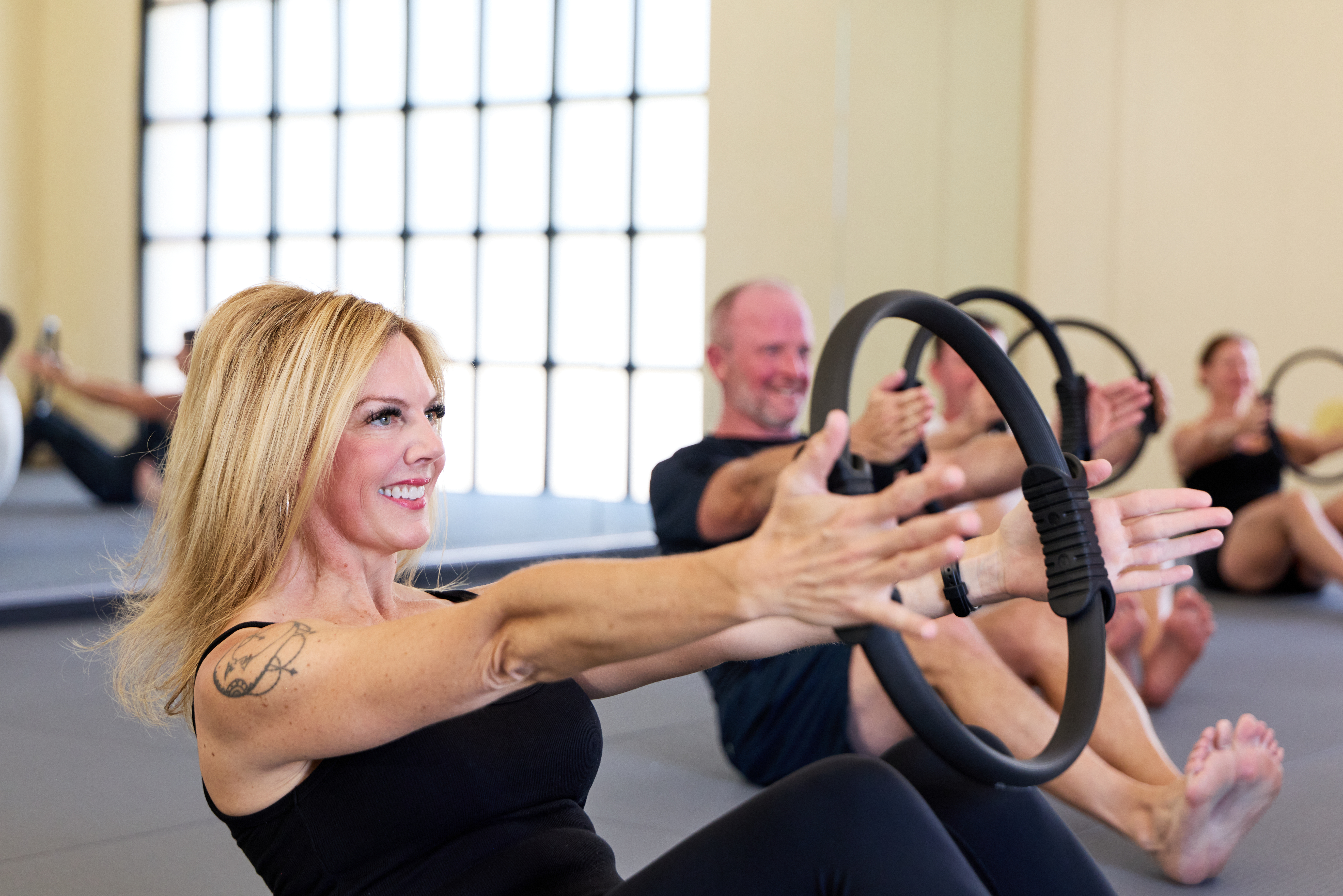
If you’ve ever peeked into a Pilates studio and wondered why some rooms are full of mats while others look like they belong in a physical therapy clinic, you’re not alone. And if you assumed the room full of machines was the harder workout, you’re in good company there too. Most people get that one backwards. Here’s what actually separates mat vs. reformer Pilates, how the other types of Pilates fit in, and how to figure out where you should start.
What’s the Difference Between Mat and Reformer Pilates, and Which One Should You Start With?
Mat Pilates is bodyweight work done on a mat, sometimes with small props like resistance bands or a Pilates ball. Reformer Pilates is done on a sliding carriage attached to adjustable springs, which add resistance to some movements and support to others. Both follow the same principles of controlled movement, breath, and core strength. The real difference is the equipment and how much help (or challenge) the springs give you.
Here’s the part that surprises people: mat is considered the more demanding of the two. The Reformer and other apparatus were originally designed to help people build the strength and control needed to master mat work. On the mat, there are no springs to assist you, so your body does all the work.
As for where to start, both are beginner-friendly. If you want a simple, drop-in-friendly entry point, start with a group mat class and treat mastering it as the long game. If you’d like more support and structure, or you’re working around an injury, a small group or private Reformer session gives you hands-on guidance from day one. Plenty of people end up doing both.
What Makes Pilates, Pilates?
No matter the format, every type of Pilates is built on the same foundation: controlled movement, breath, alignment, and (you guessed it) a strong center. What changes from style to style is the equipment, the resistance, and how much support or challenge you get along the way. Once you understand that, choosing between formats gets a lot easier.
Types of Pilates: A Quick Guide to Each Format
Mat Pilates: The Foundation
Mat Pilates is exactly what it sounds like: bodyweight exercises on a mat, using breath and control instead of machines. It’s where most people start, and it’s where experienced practitioners keep coming back, because it never stops being challenging.
- Best for: building core awareness, flexibility, and control you can take anywhere
- What to expect: flowing sequences, small props like bands or Pilates balls, and a lot of “feel the burn without ever standing up”
Reformer Pilates: Resistance With Built-In Support
The Reformer is the machine most people picture when they think “boutique Pilates studio.” It’s a sliding carriage attached to a set of springs, with a footbar and straps. Some setups also include a Tower unit with bars and extra springs. Those springs can make a movement harder or help you through it, which is something mat work can’t do.
- Best for: building strength through a full range of motion, low-impact resistance training, and targeting specific muscle groups
- What to expect: a carriage, straps, a footbar, possibly a Tower, and resistance your instructor can adjust up or down for each exercise
Classical vs. Contemporary Pilates
“Types of Pilates” can also refer to the teaching approach, not just the equipment. Classical Pilates sticks closely to Joseph Pilates’ original exercises and sequences. Contemporary Pilates keeps the core principles but adapts the exercises using modern exercise science, extra props, and more modifications. The idea that the apparatus exists to build toward mat work comes from the classical tradition.
Beyond the Reformer: Other Pilates Equipment You Might See
The Reformer isn’t the only apparatus built to help you progress toward mat. Depending on the studio, you might also see:
- Cadillac (Trapeze Table): a raised table with a frame of bars, springs, and straps overhead, used for deeper stretching and supported strength work
- Wunda Chair: a compact, chair-like apparatus with a spring-loaded pedal, great for building stability and single-limb strength
- Spine Corrector (Barrel): a curved piece of equipment that supports and deepens spinal extension and flexibility work
Mat vs. Reformer Pilates: Side-by-Side Comparison
| Mat Pilates | Reformer Pilates | |
| Equipment | Mat plus small props | Reformer machine (springs, carriage, straps) |
| Resistance | Bodyweight | Adjustable spring resistance |
| Best for | Foundational control and flexibility | Targeted strength and full-body resistance training |
| Difficulty | The most demanding form of the method | A progression that builds strength and control for mat work |
| Class size | Typically a larger group | Group, small group, or private |
| Good for beginners? | Yes | Yes, especially in small group or private sessions |
Which Type of Pilates Is Right for You?
It depends on what you want out of it. Here’s a simple way to decide.
Start With Mat If You’re Brand New
Mat is a low-cost, drop-in-friendly way to learn the fundamentals. Just know that it’s easy to start and hard to master. That’s exactly what keeps it interesting for years.
Try Reformer If You Want More Support
If you’d like structured resistance and a little extra help while you build strength, the Reformer is a great next step. Reformer Pilates for beginners works well because the springs guide your form while you learn how each movement should feel.
Go Private or Small Group If You Want One-on-One Coaching
If you’re recovering from an injury, training for something specific, or you just want more attention, private and small group Reformer sessions let you move at your own pace with hands-on coaching.
Pilates Your Way at the Village
At the Village, you don’t have to pick one format and stick with it forever. Maybe you’re looking for reformer Pilates in Scottsdale, Chandler, or Phoenix. Or maybe you just want a mat class to build your foundation. Either way, our lineup covers every stage:
- Group Mat Classes: a great entry point, or a way to keep your foundation strong
- Group Reformer Classes: build strength and control in a supportive class setting
- Small Group Reformer: more individualized attention, with the same class energy
- Private Reformer Sessions: fully customized to your goals, pace, and body
If you’re coming back from an injury, or you’d rather learn the machine before joining a group class, private reformer Pilates is a smart way to build confidence on the equipment. Our instructors work with members at every level, from first-timers to longtime practitioners. They’ll help you figure out which format fits your goals right now and when you’re ready for the next one.
Want to pair your Pilates practice with strength training? Our personal trainers can build a plan that works alongside your classes.
New to the Village? Our guide to your first 30 days walks you through how to build a routine that sticks.
Frequently Asked Questions
Is mat or reformer Pilates harder?
Mat Pilates is generally considered harder. On the Reformer, springs can assist you through a movement. On the mat, your body has to create all the control and stability on its own. That’s why the apparatus was originally designed to help people build toward mat work.
Is reformer Pilates good for beginners?
Yes. Reformer Pilates for beginners works especially well in a small group or private session. That’s where an instructor can set your springs, adjust the machine to your body, and correct your form as you learn.
Can I do both mat and reformer Pilates?
Yes, and a lot of people do. The two formats complement each other. Reformer work builds strength and control with support, and mat work tests whether you can hold that control on your own.
Should I choose group or private reformer Pilates?
Group Reformer is a great fit if you’re comfortable learning in a class and like the energy of working out with others. Private reformer Pilates is the better choice if you’re new to the machine, working around an injury, or training toward a specific goal. Small group sessions sit in between, with more individual attention while keeping the class feel.
Find Your Fit at the Village
The mat vs. reformer Pilates question doesn’t have to be either/or. Start where you feel comfortable, whether that’s a group mat class or a private Reformer session, and let your practice grow from there. Our instructors will meet you where you are and help you build the strength and control to take on your next challenge, including the mat. Come try a class and see how it feels.
Sign up for a 7-day free trial at any of our clubs – Gainey, Ocotillo, DC Ranch, or Camelback